Verified AI Toy Supplier · Onsite-checked by TÜV Rheinland · CE Certified · Worldwide B2B Export
[email protected] English
  • English
  • Español
  • Français
  • Deutsch
  • Русский
  • Português
  • العربية
  • 日本語
0%

Sourcing AI robot toys globally in 2026 requires more than comparing factory prices. Buyers must evaluate software quality, child safety, data protection, battery performance, and after-sales support. A toy may look impressive in a product video, yet fail after repeated charging or lose voice functions in a noisy room. Small details matter.

Dr. Cynthia Breazeal, an MIT roboticist and leading social-robotics researcher, has said, “The future of robotics is social.” Her observation is especially relevant to AI robot toys. These products interact with children, families, and educational environments. Suppliers should therefore explain how speech data is handled, where cloud services operate, and whether parents can disable recording features. Independent testing, clear age grading, traceable materials, and reliable firmware updates should guide supplier selection.

The sourcing process should include factory audits, sample testing, pilot orders, and transparent communication about defects. Ask for documented quality controls, not attractive promises. Check whether the manufacturer can support different languages, electrical standards, packaging requirements, and regional customer service. No sourcing plan is perfect. A spreadsheet can still miss a weak microphone, confusing setup instructions, or an unsafe charging cable. That is why buyers should test products with real families before placing large orders. Ethical sourcing also means avoiding exaggerated claims about intelligence, learning, or emotional abilities. Responsible brands describe limitations clearly. They protect children’s privacy and build trust through evidence, not excitement alone.
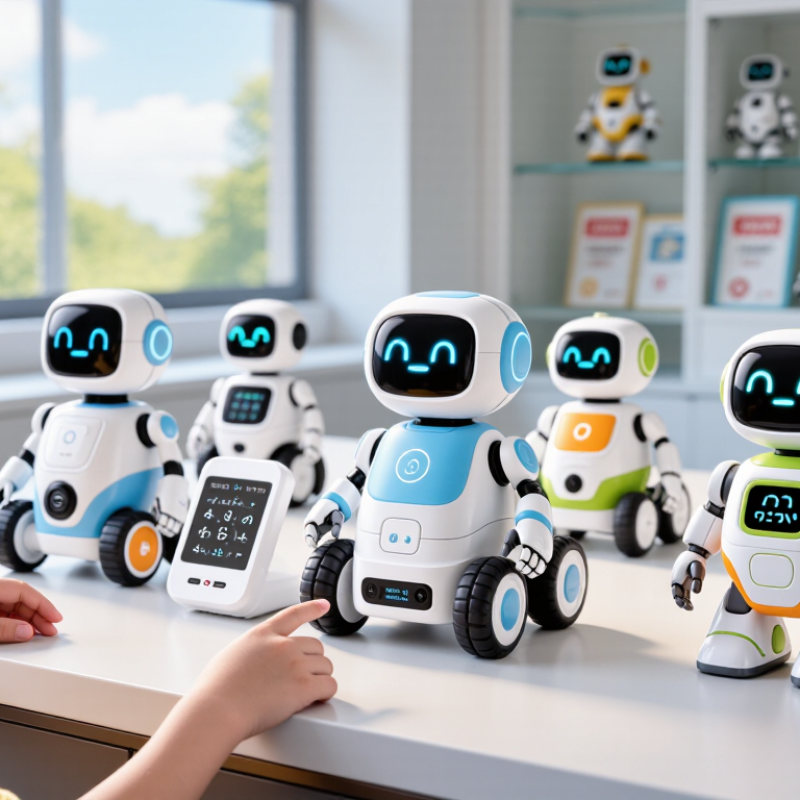
How to Source AI Robot Toys Globally in 2026?

Define the Global AI Robot Toy Market and Product Categories

In 2026, the global AI robot toy market includes play products that sense, respond, learn, or adapt through software. A simple motorized toy is not automatically an AI toy. Buyers should check whether it recognizes speech, changes behavior, or supports programmable responses.

The market serves children, families, schools, and hobby users, with different safety and usability expectations.

Product categories are becoming less fixed. Educational robots teach coding through block-based commands, while conversational companions use microphones and speech models.

STEM construction kits combine motors, sensors, and modular parts.

Some interactive pets react to touch, movement, or sound. Remote-controlled robots may add camera functions, but connectivity does not always mean meaningful intelligence.

Categories often overlap.

For global sourcing, suppliers should provide clear age grading, battery documentation, material declarations, and software support details. Privacy design also matters when toys collect voice or image data. Regional requirements can differ for radio equipment, children’s products, electrical safety, and data handling.

Experienced buyers should request sample testing, firmware records, and user manuals before discussing large orders.

A small factory sample may perform well, yet fail after repeated charging or noisy-room testing. That weakness is easy to miss.

I would also question inflated claims about learning ability, because many toys follow limited scripts rather than truly adapting.

Reliable sourcing requires evidence, not impressive demonstrations.

Set Safety, Compliance, and Ethical Requirements for AI Robot Toys

How to Source AI Robot Toys Globally in 2026?

Set safety, compliance, and ethical requirements before comparing suppliers. Require documented testing for overheating, battery failure, sharp edges, pinch points, and unstable movement. Ask for age grading, traceability records, and independent laboratory reports. A toy should not quietly record a child’s voice. Require clear consent, data minimization, deletion controls, and encrypted communication. Test the toy offline.

The World Economic Forum’s Global Cybersecurity Outlook 2025 reported that 66% of respondents expect AI to have the greatest cybersecurity impact within one year. However, only 37% had processes to assess AI security. This gap matters for connected robot toys.

Suppliers should explain software updates, remote access, vulnerability reporting, and service shutdown procedures in plain English. NIST’s AI Risk Management Framework also supports continuous testing, human oversight, and documented risk controls.

Ethical sourcing needs more than factory audits. Review worker safety, subcontractor transparency, material origins, and repair options. Avoid designs that encourage emotional dependence or collect unnecessary behavioral data. The OECD’s AI Principles emphasize transparency, robustness, safety, and accountability, which provide useful benchmarks for global procurement.

I would reject any supplier that cannot show repeatable evidence. Still, a perfect checklist is impossible. Children use products unpredictably. Run supervised trials with different ages, lighting conditions, accents, and network failures. Record what goes wrong, not only what passes. Credibility comes from admitting weak points early.

Find and Evaluate International Manufacturers and Suppliers

How to Source AI Robot Toys Globally in 2026?

International sourcing starts with measurable supplier evidence, not attractive videos. The International Federation of Robotics reported that professional service robot sales reached about 205,000 units in 2023, rising 30% year on year. This growth signals stronger manufacturing capability, but toy suppliers still need separate evaluation.

Ask for factory audit records, production capacity, traceability procedures, and recent test reports. Request a working sample from the same production line, not a showroom prototype. Check voice recognition in a noisy room, battery temperature after repeated charging, and joint strength after controlled drops. Small details expose weak engineering.

Safety comes first.

Verify testing against relevant requirements, including ISO 8124, EN 71, ASTM F963, and applicable radio and battery rules. Confirm whether the supplier controls firmware updates and protects children’s recorded data. The OECD’s digital safety research highlights growing risks involving children’s privacy and connected products. Treat software as part of product quality.

Use a supplier scorecard with weighted categories: safety documentation, firmware control, defect rate, communication speed, tooling ownership, and delivery history.

A 2024 industry analysis from Interact Analysis identified continued expansion in intelligent robotics, yet market forecasts vary widely. That uncertainty matters. A supplier may promise global scale while lacking local compliance support. Our scorecard helps, but it is not perfect. Independent inspections and pilot orders remain necessary before committing to volume.

Compare Costs, Logistics, Contracts, and Quality Control Options

Global sourcing of AI robot toys in 2026 starts with a cost model, not a catalog price. A factory quote may exclude tooling, software updates, batteries, testing, packaging, and inland transport. Ask for landed-cost estimates at 500, 2,000, and 10,000 units. Small orders often carry surprisingly high setup charges. A low unit price can hide expensive rework. That lesson still matters.

LOGISTICS Logistics planning should match the toy’s battery type, carton size, and delivery season. Request carton dimensions, gross weight, production lead time, and backup routing in writing. Air freight protects launch dates, while ocean freight usually reduces cost. Build buffer time for inspections and port delays. Do not promise a holiday launch from an ideal schedule. It sounds obvious. Yet buyers still do it. Track samples with dated photos and signed packing records.

Contracts should define acceptable defect limits, repair duties, replacement timing, software support, and payment milestones. For toys using microphones or cameras, require clear data-handling terms and documented child-safety compliance. An independent laboratory can verify electrical, mechanical, battery, and chemical requirements for each target market. Run a pilot batch before mass production. Check voice responses, charging ports, wheel movement, carton damage, and missing accessories. A 50-unit pilot may reveal problems hidden in polished samples. My own preference is strict inspection, but excessive checks can slow a seasonal launch. The right balance needs evidence, not assumptions.

Plan Importation, Launch, and Ongoing Supplier Management

How to Source AI Robot Toys Globally in 2026?

Import planning should begin with the product file, not the purchase order. Define the robot’s functions, age range, battery type, packaging, and intended market. Confirm the correct customs classification with a qualified trade specialist. Request safety test reports, battery transport documents, radio approvals, and software privacy information before production. A factory video call is useful, but an independent inspection is stronger evidence. Check sample units for loose parts, sharp edges, charging heat, voice response, and packaging damage.

Launch preparation needs a controlled pilot shipment. Order a limited quantity first, then test delivery time, customer instructions, return handling, and local language content. Keep spare chargers and replacement parts available. A simple dashboard should track defect rates, response time, shipment accuracy, and unresolved complaints. These figures create a more reliable supplier discussion than optimistic promises.

Supplier management continues after launch. Schedule monthly reviews and quarterly quality audits. Share defect photos with batch numbers and corrective deadlines. Reconfirm software updates, component changes, and factory subcontracting in writing. Forecasts will be imperfect. Mine was once too optimistic. That mistake caused excess inventory and weaker cash flow. Now, I use conservative demand scenarios and release larger orders only after repeat performance. Price matters, but stable quality, transparent communication, and documented corrective action protect the business longer.

FAQS

What evidence should I request from an international robot toy supplier?

Request factory audit records, production capacity, traceability procedures, and recent safety reports. Ask for a working sample from the actual production line. A showroom prototype proves very little.

How can I test a robot toy sample properly?

Test voice recognition in a noisy room. Check battery temperature after repeated charging. Drop the unit in controlled tests and inspect its joints. Look for loose parts, sharp edges, and charging damage.

Which safety documents are important before production?

Request toy safety reports, battery transport documents, radio approvals, and software privacy information. Confirm testing for your target market. Missing paperwork should pause the order.

How should I evaluate connected features and children’s privacy?

Ask who controls firmware updates and recorded voice data. Confirm how data is stored, deleted, and protected. Software quality matters as much as plastic quality.

What should a supplier scorecard include?

Score safety documents, defect rates, communication speed, tooling ownership, and delivery history. Add corrective-action performance. The scorecard helps, but it cannot replace independent inspections.

Why is a pilot shipment useful?

A limited shipment reveals delivery delays, packaging damage, unclear instructions, and return problems. Test a small batch before committing to larger quantities. Keep spare chargers and replacement parts nearby.

How should I manage the supplier after launch?

Schedule monthly reviews and quarterly quality audits. Share defect photos with batch numbers and deadlines. Confirm software changes, component changes, and subcontracting in writing.

How should I plan demand and larger orders?

Use conservative demand scenarios and release larger orders after repeated performance. My forecast was once too optimistic. Excess inventory weakened cash flow, so I now move more carefully.

Which matters more, low price or stable quality?

Stable quality, clear communication, and documented corrections usually protect the business longer. A cheap unit with frequent returns can become expensive. Price still matters, but it is not enough.

Conclusion

Sourcing AI robot toys globally in 2026 requires a structured approach that balances market demand, product innovation, safety, and operational reliability. Start by defining the target market and identifying suitable categories, such as educational robots, interactive companions, programmable kits, and remote-controlled smart toys. Establish clear requirements for age suitability, data protection, cybersecurity, materials, battery safety, labeling, and responsible artificial intelligence features before contacting suppliers.

Next, evaluate international manufacturers through product samples, technical documentation, factory audits, production capacity, communication quality, and quality-control systems. Compare total costs, including tooling, unit prices, shipping, insurance, tariffs, testing, and warehousing, while reviewing payment terms, minimum order quantities, lead times, warranties, and contract protections. A successful launch also depends on reliable import procedures, accurate documentation, localized packaging, customer support, and a practical plan for monitoring product quality and supplier performance after launch. Regular reviews, inspections, and risk assessments can help maintain compliance, control costs, and build a stable long-term supply chain.

Ethan

Ethan

Ethan is a dedicated marketing professional with a strong understanding of the company’s products, customers, and industry landscape. With a practical approach to communication and a passion for continuous learning, he regularly creates and updates the company’s professional blog, sharing useful......