Verified AI Toy Supplier · Onsite-checked by TÜV Rheinland · CE Certified · Worldwide B2B Export
[email protected] English
  • English
  • Español
  • Français
  • Deutsch
  • Русский
  • Português
  • العربية
  • 日本語
0%

What Is the Top AI Robot Dog for Global Buyers? The answer depends on verified performance, not dramatic demonstrations. A capable AI robot dog should navigate uneven floors, stairs, warehouses, farms, and construction areas with dependable balance. It should also provide clear specifications for battery life, payload, cameras, sensors, connectivity, and operating temperature.

Industry data shows why this category deserves careful attention. The International Federation of Robotics reported nearly 205,000 professional service robots sold worldwide in 2023, representing approximately 30% annual growth. Its World Robotics 2024 report identifies logistics, transportation, cleaning, and inspection as major commercial applications. Goldman Sachs Research has also projected strong long-term expansion for the global robotics market, supported by automation, labor shortages, and improving artificial intelligence. These figures describe robotics broadly, not robot dogs alone. That distinction matters.

For global buyers, the top AI robot dog should combine mobility with practical deployment support. Look for autonomous mapping, obstacle avoidance, remote supervision, secure data handling, and a documented software-update policy. Check whether the supplier offers local training, spare batteries, repair access, and multilingual technical support. A machine that walks beautifully for ten minutes may fail during a full inspection shift. Real-world reliability is less exciting, but more valuable. Buyers should compare independent demonstrations, warranty terms, cybersecurity practices, and relevant safety certifications before purchasing. Marketing claims can still run ahead of field evidence. My view may change as testing improves, because this market remains young, uneven, and difficult to compare across regions.
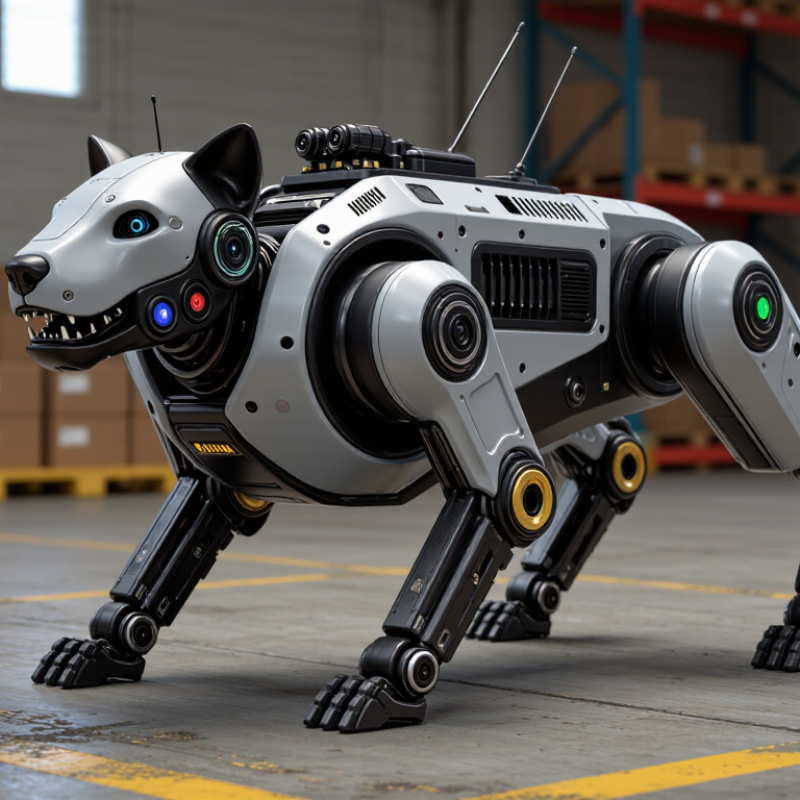
What Is the Top AI Robot Dog for Global Buyers?

AI Robot Dog Market Metrics: Growth, Deployment Rates, and Buyer Segments

For global buyers, the top AI robot dog is not simply the fastest or most athletic. It is the platform that performs reliably under local conditions and measurable operating goals. Market tracking shows strong double-digit growth expectations, driven by industrial inspection, logistics, research, and safety training. Yet growth figures vary by region and definition. Some reports count demonstrations as deployments. That weakens comparisons. Serious buyers should separate paid installations, active monthly units, and pilot projects.

Deployment rate is more useful than shipment volume. A unit used five days weekly offers stronger evidence than ten idle machines. Buyers should monitor mission completion, false alarms, uptime, battery cycles, repair intervals, and operator training hours.

In a warehouse, a practical trial might record stair performance, wireless recovery, and inspection time per shift. In outdoor sites, dust, rain, uneven ground, and temperature matter. Field logs reveal more than polished demonstrations. They also expose weaknesses.

Buyer segments are becoming clearer. Manufacturers prioritize uptime and sensor integration. Energy and infrastructure teams value remote inspection and hazard reduction. Universities often need open development tools and repeatable data. Smaller contractors may focus on leasing costs, service access, and simple controls. Procurement teams should compare total ownership costs, not purchase price alone. A low-cost unit can become expensive after repeated battery replacement or specialist support. I would still question every forecast. Deployment data remains uneven, and regional skills shortages can distort results.

Core Hardware Benchmarks: Payload, Speed, Battery Runtime, and IP Ratings

What Is the Top AI Robot Dog for Global Buyers?

A strong AI robot dog should be judged by measured hardware, not clever demonstrations. Payload is the first filter. For inspection work, a useful platform should carry at least 5–10 kilograms while walking steadily. Buyers must check whether this figure includes batteries, sensors, or only an external load. The difference matters.

Speed needs equal caution. A peak speed near 3 meters per second looks impressive, but working speed is often closer to 1–2 meters per second. Battery runtime should be tested during movement, sensing, and wireless communication. Marketing figures often describe idle operation. A realistic target is 90–150 minutes under mixed field use. Carrying heavier equipment can reduce endurance sharply. That is easy to overlook.

Weather protection is not a decoration. IEC 60529 defines IP ratings, while an IP65 enclosure resists dust and water jets, not immersion. Outdoor buyers should request test conditions, temperature ranges, and port-cover details. The International Federation of Robotics reported 541,302 industrial robot installations in 2023, showing how quickly automation is entering demanding workplaces. Yet that report does not prove field reliability for quadruped robots. Buyers still need independent trials, measured payload tests, and repeatable battery data. The best platform may not be the fastest. It may be the one that walks reliably after rain, carries the required sensor package, and still returns safely with reserve power. Even this standard needs review. Terrain changes everything.

AI Capabilities Compared: SLAM, Edge Computing, Sensors, and ROS 2 Support

For global buyers, the best AI robot dog is not defined by speed alone. Its navigation stack matters more in warehouses, farms, and uneven industrial sites. SLAM combines lidar, cameras, and inertial data to build a live map. During a practical trial, the robot should locate itself after bright sunlight, dust, or a blocked corridor. Relocalization is critical. A robot that loses its map near stacked cartons creates operational risk.

Edge computing keeps perception and movement decisions close to the robot. This reduces dependence on cloud connections and can improve response time. It also limits data transfers, which supports stronger privacy practices. Ask for measured latency, not attractive marketing language. Sensor quality deserves equal scrutiny. Lidar detects structure, cameras add visual context, and depth sensors estimate obstacles. Yet rain, glare, reflective floors, and loose gravel can confuse them. No sensor is perfect.

ROS 2 support can simplify integration with existing research and automation systems. Buyers should check middleware versions, driver documentation, simulation tools, and update policies. A claimed ROS 2 connection means little if developers cannot access reliable interfaces. I would test mapping, obstacle avoidance, and recovery behaviors with the intended payload. Small failures matter. One weak sensor mount or delayed motor command may expose a larger design issue. I still question any system that hides logs behind vague dashboards. Transparent diagnostics often matter more than impressive demonstrations.

What Is the Top AI Robot Dog for Global Buyers? – AI Capabilities Compared: SLAM, Edge Computing, Sensors, and ROS 2 Support
Capability Profile Typical Use Case SLAM and Navigation On-Device Computing Core Sensor Package ROS 2 Support AI Functions Connectivity Global-Buyer Suitability
Professional Inspection Platform Industrial facilities, utilities, construction sites, and outdoor asset inspection 3D LiDAR-inertial SLAM; supports autonomous waypoint navigation and map reuse Embedded GPU or AI accelerator; local perception, obstacle avoidance, and mission execution 3D LiDAR, stereo or RGB-D cameras, IMU, joint encoders, and optional thermal camera Full support or official integration Object detection, terrain classification, remote inspection, anomaly detection, and automatic return-to-home Wi-Fi, Ethernet, and optional cellular connectivity; encrypted remote operation is commonly available Excellent
Research and Development Platform Universities, robotics laboratories, algorithm development, and multi-robot research LiDAR, visual, or LiDAR-visual SLAM; configurable localization and navigation stacks Upgradeable onboard computer; supports containerized workloads and custom inference models IMU, cameras, LiDAR, motor feedback, and expansion ports for additional sensors Native or well-documented ROS 2 integration Custom perception, reinforcement learning, manipulation experiments, and navigation research Wi-Fi, Ethernet, USB, and developer-accessible interfaces Excellent for developers
Public-Safety and Security Platform Perimeter patrol, emergency response, hazardous-area observation, and night monitoring LiDAR or visual-inertial SLAM with geofenced routes and low-light navigation support Edge AI computer for low-latency detection when cloud access is unavailable LiDAR, low-light camera, wide-angle camera, IMU, microphones, and optional thermal imaging Partial support; often dependent on the software configuration Human and vehicle detection, intrusion alerts, voice communication, and thermal screening Wi-Fi and cellular backhaul; remote command quality depends on network coverage Very good
Education and Training Platform Teaching robotics, programming, computer vision, and introductory autonomous navigation Basic visual or 2D LiDAR SLAM; suitable for mapped indoor environments Embedded CPU or compact AI computer; suitable for lightweight models and ROS 2 nodes Depth camera or stereo camera, IMU, wheel-free leg odometry, and joint position sensors Usually available through standard middleware or developer packages Simple object recognition, teleoperation, navigation demonstrations, and coding exercises Wi-Fi, USB, and local network control Good for classrooms and laboratories
Consumer and Demonstration Platform Indoor entertainment, demonstrations, media production, and basic remote observation Visual-inertial localization or preconfigured indoor navigation; advanced SLAM may be limited Compact onboard processor; cloud-assisted features may be used for non-critical applications Wide-angle cameras, IMU, joint encoders, microphones, and basic obstacle sensors Limited, community-based, or unavailable Gesture response, voice interaction, basic tracking, preset movements, and remote control Wi-Fi and Bluetooth; cellular connectivity is uncommon Best for demonstrations
Evaluation note: The profiles describe capability classes rather than specific companies or branded products. Actual performance depends on sensor resolution, computing hardware, software maturity, terrain, lighting, network availability, payload, battery condition, and regional support. ROS 2 compatibility should be verified by checking supported distributions, drivers, SDK access, and available simulation packages before purchase.

Safety and Compliance: ISO 13482, IEC 60529, and Global Certification Needs

What Is the Top AI Robot Dog for Global Buyers?

Safety and Compliance: ISO 13482, IEC 60529, and Global Certification Needs

A reliable AI robot dog should arrive with evidence, not impressive demonstrations alone. ISO 13482 addresses safety requirements for personal-care robots, including foreseeable misuse, movement hazards, and human interaction. However, it is not an automatic global market certificate. The product’s intended use matters. A security, inspection, or education robot may need additional risk assessments and regional requirements. The International Federation of Robotics reported 541,302 new industrial robots installed worldwide in 2023, with 4.28 million operating units. This scale makes documented safety controls increasingly important.

IEC 60529 defines IP protection ratings. An IP65 enclosure is dust-tight and resists water jets. It is not designed for immersion. IP67 covers temporary immersion under specified test conditions, but it does not guarantee long-term outdoor durability. Buyers should request accredited laboratory reports, not only printed ratings.

Check emergency stopping, battery protection, charging temperatures, fall detection, remote-command security, and accessible pinch points. Regional compliance may also involve electrical safety, electromagnetic compatibility, radio equipment, battery transport, and product labeling. Requirements differ across the European Union, North America, and Asia-Pacific markets. There is no universal shortcut.

The difficult part is admitting uncertainty. A robot may pass a laboratory test yet behave poorly on wet stairs or crowded floors.

NIST’s AI Risk Management Framework supports continuous monitoring, but real-world logs and incident reviews remain essential.

Ask for traceable test dates, software versions, corrective-action records, and clear operating limits. Safety claims should be specific. Surface confidence is not enough.

Total Ownership Analysis: Price, Maintenance, Warranty, and Five-Year ROI

What Is the Top AI Robot Dog for Global Buyers?

The strongest choice depends on five-year ownership, not showroom movement. Commercial quadruped robots commonly cost about $10,000–$40,000 before sensors, software, training, and shipping. Public procurement quotations vary widely, so buyers should request itemized invoices. IFR’s World Robotics 2024 report recorded 541,302 industrial robot installations in 2023. This signals wider automation adoption, but it does not prove every robot dog will deliver savings.

A realistic five-year model should include annual servicing, battery replacement, spare actuators, operator training, and secure software support. I would reserve 8–15% of the purchase price yearly for maintenance, depending on terrain and duty cycles. A battery may require replacement within two to four years. Warranty coverage is often limited to twelve or twenty-four months, while accidental damage usually sits outside standard terms. Read the exclusions carefully.

For example, a $25,000 unit with $3,000 yearly maintenance and $6,000 in battery and repairs could reach $46,000 over five years. If it replaces 800 inspection hours annually at $35 per hour, the calculated benefit is $140,000. That suggests a positive gross return, but deployment delays can weaken it. NIST’s AI Risk Management Framework stresses validity, reliability, safety, and accountability. Those principles matter in outdoor operations. I would test recovery after rain, dust, weak connectivity, and a failed sensor. One uncomfortable truth remains: impressive autonomy can hide expensive human supervision.

FAQS

What makes a robotic dog suitable for global buyers?

Reliable operation matters more than speed or athletic movement. It should match local weather, terrain, connectivity, and operating goals. Demonstrations alone prove little.

How should buyers measure deployment success?

Separate paid installations, active monthly units, and pilot projects. Track mission completion, false alarms, uptime, battery cycles, repairs, and training hours. Shipment totals can mislead.

What should a warehouse trial include?

Record stair performance, wireless recovery, and inspection time during each shift. Note failures, delays, and operator workload. Real logs matter.

Which buyer groups have different priorities?

Manufacturers often need high uptime and sensor integration. Infrastructure teams may value remote inspection and reduced exposure to hazards. Universities usually need open tools and repeatable data.

How can smaller contractors control ownership costs?

Compare leasing, batteries, repairs, training, and specialist support. A cheaper unit may cost more after repeated battery replacement. The calculation is easy to underestimate.

What safety evidence should buyers request?

Request risk assessments, emergency-stop tests, battery protection records, and fall-detection results. Check charging temperatures and accessible pinch points. Ask for dated reports.

What do IP65 and IP67 ratings indicate?

IP65 generally means dust protection and resistance to water jets. IP67 allows temporary immersion under specified test conditions. Neither guarantees long-term outdoor durability.

Why should buyers question laboratory certification?

A unit may pass controlled tests yet fail on wet stairs or crowded floors. Review software versions, incident records, operating limits, and corrective actions. Uncertainty remains.

Conclusion

The global AI robot dog market is expanding as buyers seek versatile platforms for inspection, security, research, logistics, and industrial support. This summary compares market growth, deployment trends, and major buyer segments while focusing on practical hardware benchmarks such as payload capacity, movement speed, battery runtime, durability, and IP protection. These factors help organizations match a robot’s physical performance with demanding indoor and outdoor operating conditions.

It also evaluates intelligent functions, including SLAM navigation, edge computing, multi-sensor integration, and ROS 2 support, which influence autonomy, flexibility, and system integration. Safety and compliance are equally important, with attention to ISO 13482, IEC 60529, and regional certification requirements. Finally, buyers should assess total ownership costs, including purchase price, maintenance, warranty coverage, software support, and projected five-year return on investment. The best choice is not necessarily the most advanced model, but the solution that delivers reliable performance, responsible operation, and measurable long-term value.

Elowen

Elowen

Elowen is a dedicated marketing professional with a strong understanding of the company’s products, customers, and evolving market needs. With a talent for translating complex product information into clear, engaging insights, Elowen regularly contributes professional articles to the company’s......